Rob Roy MacGregor: A Highland Life Told as Story
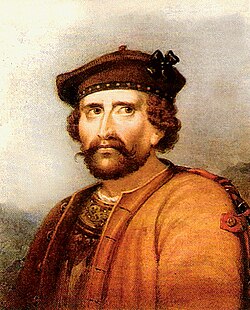 In the rugged hills where Loch Katrine gathers the sky and the mountain burns meet the water’s edge; a child was baptized in early March of 1671. His family named him Robert — Raibeart Ruadh in the Gaelic of his people — for the red hair that crowned his head like autumn bracken. The world would remember him, not as Robert, but as Rob Roy MacGregor.
He was born into Clan Gregor, a people both proud and persecuted. For generations, their very name had been outlawed, their rights stripped, their identity chased into hiding. Because of this, young Rob sometimes had to live under the borrowed name Campbell, taken from his mother’s kin. Yet no matter what name he bore, the blood of Clan Gregor flowed unmistakably in his stride, his temper, and his loyalty.
As a boy, Rob learned the Highland skills that mattered more than letters: how to track a stag by the turn of a leaf, how to sense a coming storm by the weight of the wind, how to handle cattle across treacherous passes, and how to wield a broadsword with fearless precision. These lessons prepared him for a world in which survival required cunning, strength, and — above all — a sense of who one truly was.
When Rob was eighteen, Scotland once again found itself torn between rival kings. The fiery Viscount Dundee raised the standard of the exiled James VII, and the Highland clans rallied to him. Rob and his father marched at their side. At Killiecrankie, Rob saw his first battle — a terrifying, thunderous charge that shattered the government line but claimed the life of Dundee. That moment was a turning point for the Jacobite cause… and for Rob himself. The rising failed, his father was later imprisoned on treason charges, and Rob’s mother died while he languished behind bars. Hardship had entered the MacGregor household, and it never truly left.
Yet Rob was made of the kind of resilience only the Highlands can forge. In his twenties he turned to the business he knew best: cattle. Driving great black herds across the mountains, negotiating with Lowland landowners, building alliances and making enemies — Rob Roy became a name spoken with both respect and caution. He built a protective “Watch” that kept herds safe from thieves… or ensured they were returned for a fee. In an age where government reach was thin and clan justice ruled the glens; this was as legitimate a profession as any other.
In 1693, Rob married Mary MacGregor of Comar, a woman as steadfast as the hills she was born in. Together they raised four sons — James, Ranald, Coll, and young Robert — and built a home at Inversnaid on the eastern shores of Loch Lomond. For a time, prosperity smiled on them.
But prosperity is a fickle companion in the Highlands.
Around 1711, seeking to expand his trade, Rob borrowed a large sum of money from the powerful Duke of Montrose. It was a gamble — and one that cost him dearly. When Rob’s chief drover vanished with the funds, Montrose showed no mercy. Lands were seized. Rob was declared an outlaw. His home was taken. His family cast from their hearth. What began as a business disaster ignited into one of the most famous blood feuds in Scottish history.
Now homeless but not defeated, Rob took shelter on lands held by the Earls of Breadalbane, old rivals of Montrose. From there he struck back: lifting cattle from Montrose’s estates, seizing rents meant for Lowland landlords, capturing officials who came too boldly into the glens. These actions made Montrose furious, the government wary, and Rob Roy something more than a man. He became a story — a Highland Robin Hood whose exploits traveled faster than he ever could.
Then came the Jacobite Rising of 1715. Scotland stood divided again, and Rob’s loyalties — to clan, to kin, to old alliances — pulled him in different directions. He did not fully commit at the Battle of Sheriffmuir, a choice that earned him suspicion from both sides but kept his men alive. When the rising collapsed, he was branded a traitor once more.
The years that followed were marked by pursuit and escape, skirmish and negotiation. Rob fought again in the 1719 rebellion, suffered wounds, dodged capture, and continued to roam the hills that had shaped him. Eventually, the law caught up with him. He was taken south to London, locked in the infamous Newgate Prison, and even sentenced to transportation to the colonies. But fate — and perhaps the legend growing around his name — intervened. Rob received a royal pardon and returned home.
In his later years, he settled quietly in Balquhidder, embraced the Catholic faith, and watched his sons take up their places in the changing Scotland around them. No longer a fugitive, no longer a raider, Rob Roy lived out his final days among the soft, rolling hills of the glen.
On 28 December 1734, he died at the age of 63. He was laid to rest in Balquhidder Kirkyard, beneath the simple yet defiant words:
“MacGregor Despite Them.”
Even in death, his identity could not be erased.
Today, visitors still stand at his graveside, feeling the wind that once carried the sound of his footsteps. Rob Roy MacGregor remains Scotland’s most legendary outlaw — not because he was perfect, but because he was human: bold, flawed, loyal, clever, and unbreakable. A man forged by hardship, shaped by the land, and carried into legend by the power of story.
